
Interactive explainers
Charts, calculators and simulations you can change, built on real numbers from papers, model files and production systems. Free for teaching under CC BY-SA 4.0.
Diagram
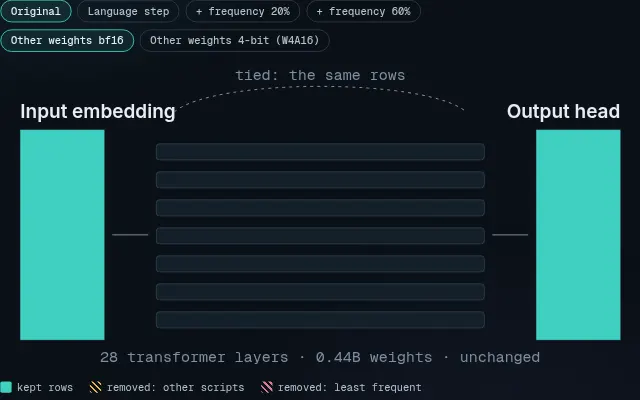
Trimming touches two tables, and in a tied model they are the same one
Interactive diagram of Qwen3-0.6B: input embedding and tied output head drawn to scale against 28 unchanged layers, for the original vocabulary (151,669 rows), the language step (109,357) and frequency trims of 20% (87,498) and 60% (43,755).
Vocabulary trimming, compared: what SqueezeBits measured on the phone, and the tokenizer check that makes it safe
Interactive chart
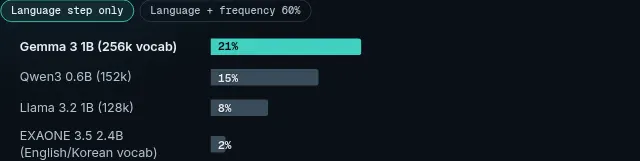
The bigger the vocabulary, the more trimming buys on a phone
Gains in the decode-heavy setting (64 tokens in, 512 out) as stated in the SqueezeBits post.
Vocabulary trimming, compared: what SqueezeBits measured on the phone, and the tokenizer check that makes it safe
Simulation
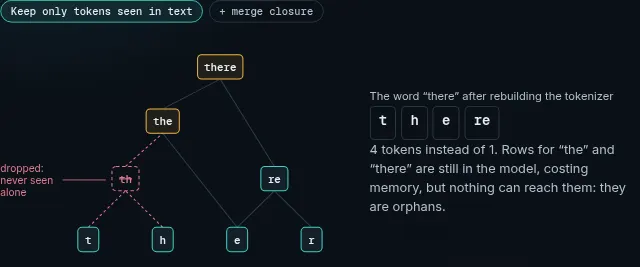
Drop one piece nobody “uses”, and the words built on it fall apart
Interactive BPE merge tree for "there": without merge closure the parent "th" is dropped and the word splits into 4 tokens.
Vocabulary trimming, compared: what SqueezeBits measured on the phone, and the tokenizer check that makes it safe
Interactive chart
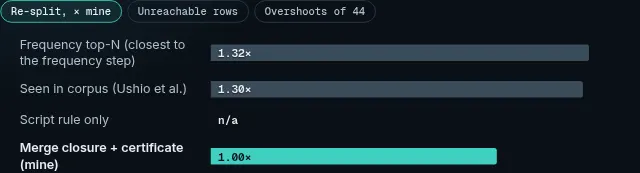
Same compression, more broken text, and no warning before you ship
Re-split: how much new text the rule splits differently, at the same number of rows removed, as a multiple of the merge-closed rule (median).
Vocabulary trimming, compared: what SqueezeBits measured on the phone, and the tokenizer check that makes it safe
Annotated screenshot
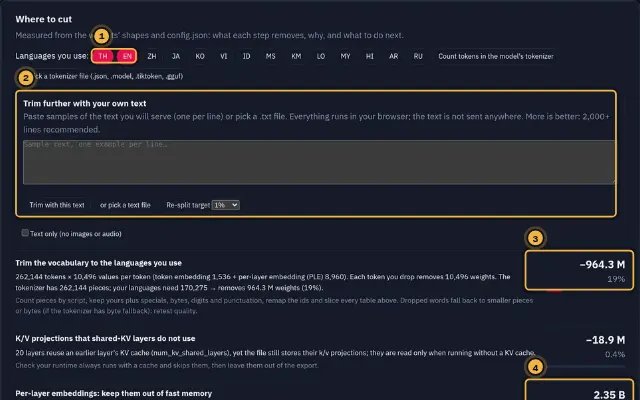
Gemma 4 E2B, served in Thai and English: one fifth of the weights are rows you never select
The Where to cut panel after loading google/gemma-4-E2B-it and counting the model's own tokenizer.
The vocabulary tax: the token tables your users never touch, and how to trim them safely
Interactive chart
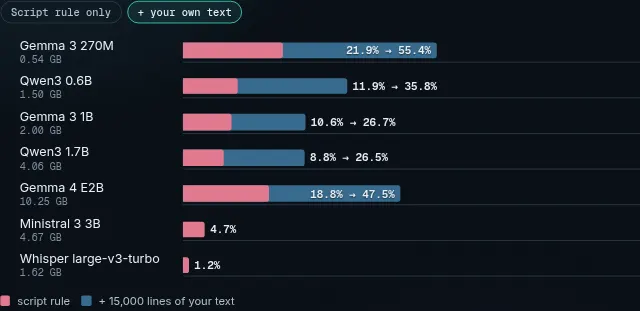
The smaller the model, the bigger the share you never use
Interactive bar chart: removable share of stored bytes for seven reference models, script rule against 15,000 Thai lines (paper Table 13).
The vocabulary tax: the token tables your users never touch, and how to trim them safely
Interactive chart
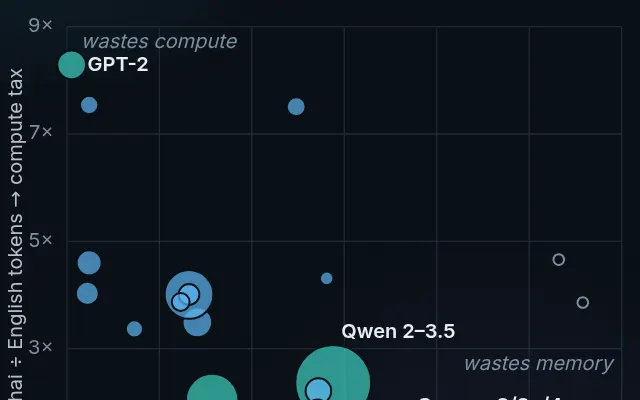
A Thai user pays a memory tax or a compute tax. The tokenizer picks which.
Interactive scatter: rows unused by Thai and English against Thai-to-English token ratio for 19 tokenizer families (paper Table 1).
The vocabulary tax: the token tables your users never touch, and how to trim them safely
Interactive chart
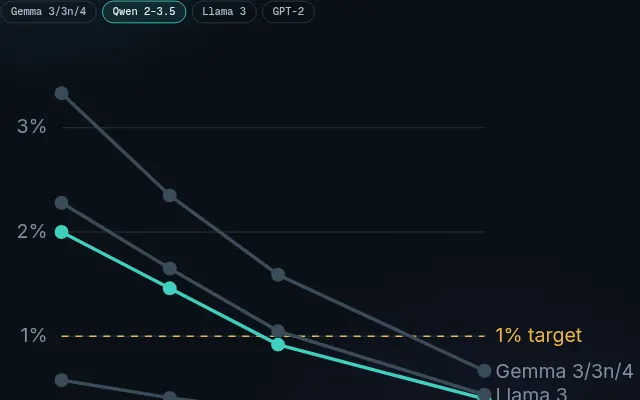
Each doubling of your text cuts the re-split rate by about a third
Interactive line chart: real re-split rate of new Thai text against trimming lines for four tokenizer families (paper Table 5).
The vocabulary tax: the token tables your users never touch, and how to trim them safely
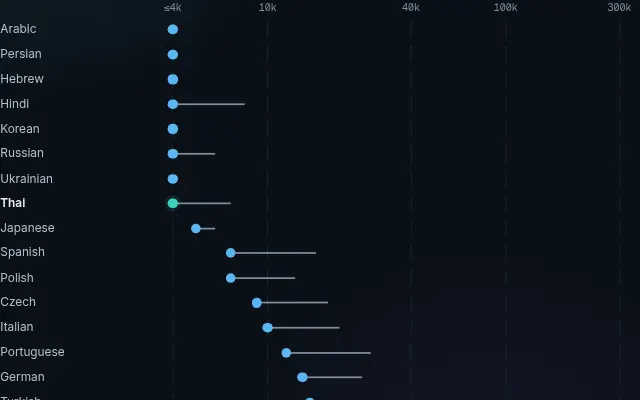
Interactive chart
Thai needs about 4,000 lines of real text. English web text needs 190,000.
Interactive dot plot: lines of own text needed for a 1% re-split rate in 20 languages (paper Table 9).
The vocabulary tax: the token tables your users never touch, and how to trim them safely
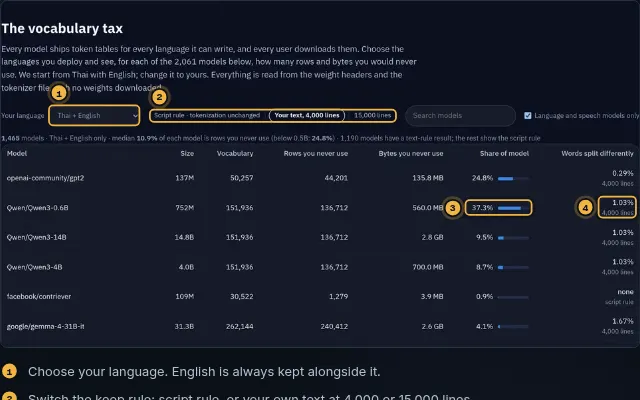
Annotated screenshot
Look up any model before you download it
The vocabulary tax table on the Hub Weight Census page, Thai + English with 4,000 lines of text: Qwen/Qwen3-0.6B never uses 37.3% of the model, with 1.03% of words split differently.
The vocabulary tax: the token tables your users never touch, and how to trim them safely
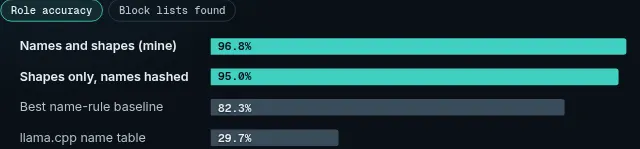
Interactive chart
Hide every name and the method still gets 95% of roles right
Ground truth is the Python class of each module, which the method never sees.
Reading a model's architecture from its safetensors header, and what 12,974 Hugging Face models reveal
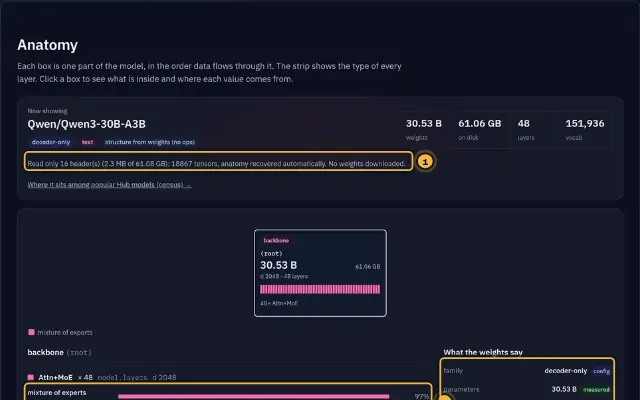
Annotated screenshot
A 61 GB mixture-of-experts model, read from 2.3 MB of headers
The Anatomy view after pasting Qwen/Qwen3-30B-A3B.
Reading a model's architecture from its safetensors header, and what 12,974 Hugging Face models reveal
Annotated screenshot
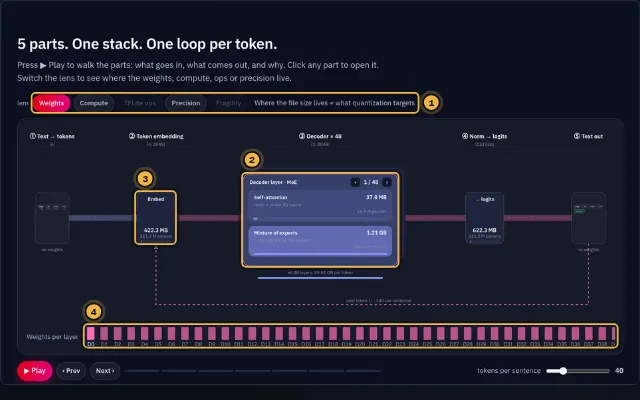
Five parts, one stack, one loop per token
The same model in the parts view, with the Weights lens on.
Reading a model's architecture from its safetensors header, and what 12,974 Hugging Face models reveal
Interactive chart
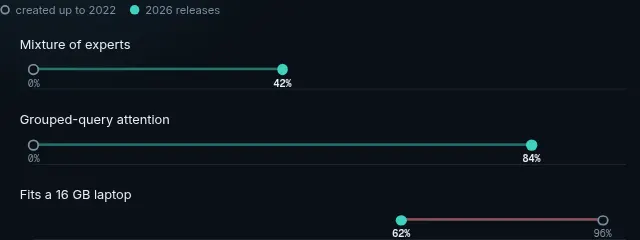
In four years, MoE and grouped-query attention went from nothing to normal, and fewer new models fit a laptop
Share of popular original language models created up to 2022 against those released in 2026.
Reading a model's architecture from its safetensors header, and what 12,974 Hugging Face models reveal
Simulation
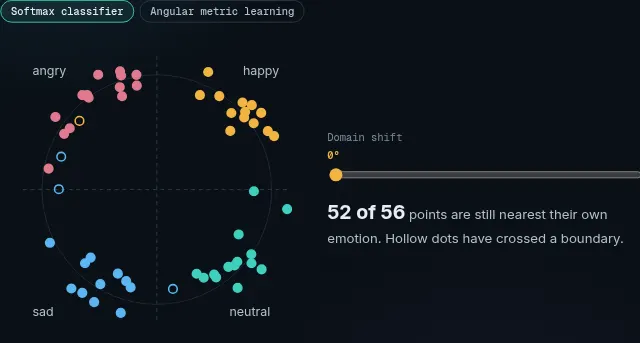
Tight clusters survive a shift that pushes loose ones over the line
Interactive: synthetic emotion embeddings under a domain shift; tight angular clusters stay correct where softmax clusters cross boundaries.
Why emotion models fall apart outside the lab (and what actually helps)
Annotated screenshot
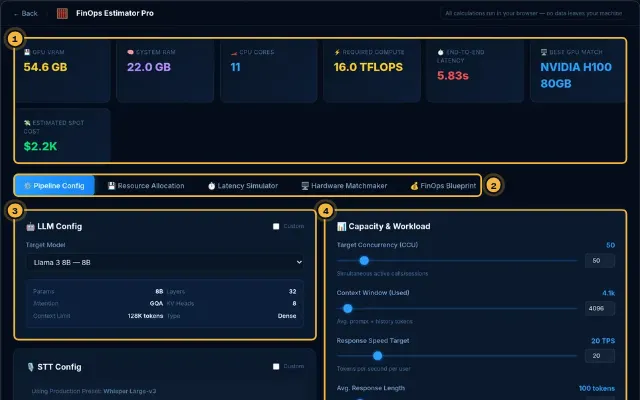
Fifty concurrent voice sessions on an 8B model fit one 80 GB GPU
The calculator with its default pipeline: Whisper large-v3, Llama 3 8B and XTTS-v2, 50 concurrent sessions, 4,096 tokens of context, FP16 weights.
FinOps-Estimator: sizing GPUs for a voice AI pipeline

Interactive chart
The same 70B model needs 140 GB in bf16 and about 36 GB in 4-bit
N × bits ÷ 8, in GB of 10⁹ bytes.
Fitting an LLM in your own server room: the memory math behind on-prem AI
Simulation
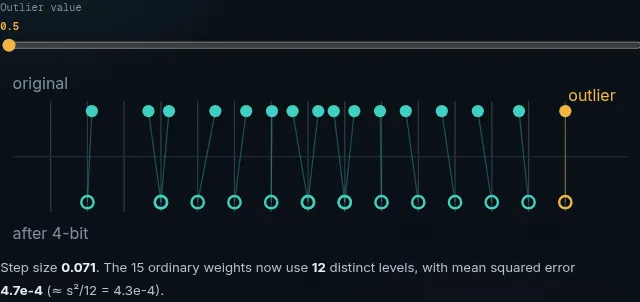
One large weight makes every other weight in its group less precise
Interactive: 16 weights quantized to 4 bits with one scale; raising one outlier coarsens the grid for all others.
Fitting an LLM in your own server room: the memory math behind on-prem AI
Calculator
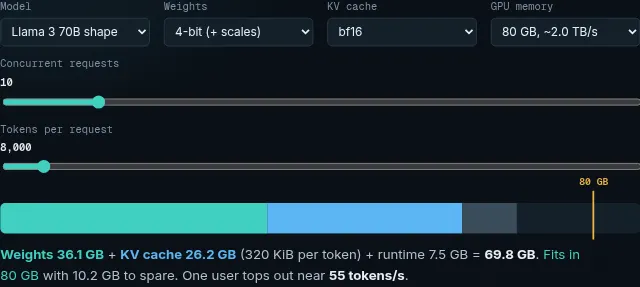
Will it fit, and how fast can one user read it?
Calculator: weights + KV cache + 12% runtime for Llama 3 8B/70B shapes against GPU memory, with the single-stream speed ceiling.
Fitting an LLM in your own server room: the memory math behind on-prem AI
Simulation
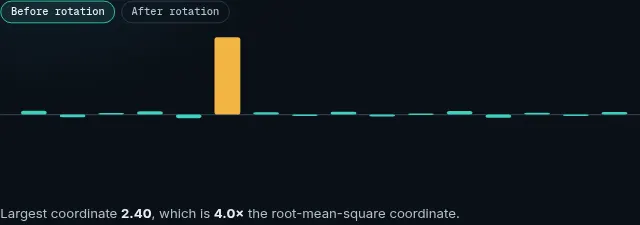
A rotation turns one huge coordinate into sixteen ordinary ones
Interactive: a 16-dimensional vector with one outlier before and after a Walsh-Hadamard rotation; the peak falls from 4.0x to 1.3x the RMS.
TurboQuant, reviewed: when a theory paper walks straight into production
Calculator
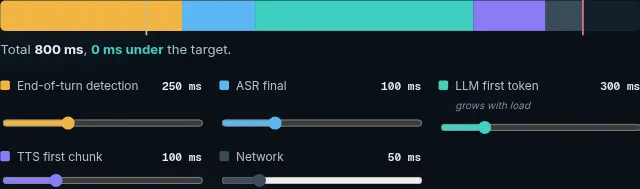
About 800 ms from your last word to its first syllable, and end-of-turn detection is the biggest slice
Interactive latency budget: end-of-turn 250 ms, ASR 100 ms, LLM first token 300 ms, TTS 100 ms, network 50 ms against an 800 ms target.
Your MAU is not your load: capacity math for voice AI at scale
Calculator
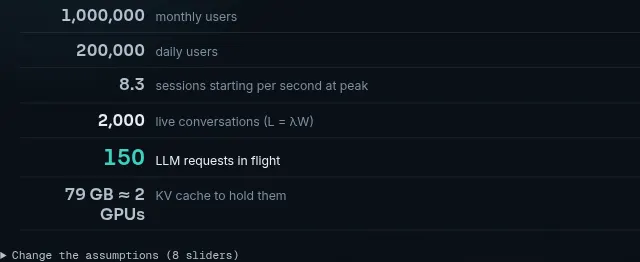
A million monthly users is about 150 LLM requests in flight at peak
Calculator: monthly users to daily users, peak arrivals, live sessions (Little's law) and LLM requests in flight, then KV memory.
Your MAU is not your load: capacity math for voice AI at scale