
TurboQuant, reviewed: when a theory paper walks straight into production
A close read of TurboQuant (ICLR 2026): random rotations, Lloyd–Max codebooks and a 1-bit QJL residual, and why it went from proof to vLLM and a 17k-star vector index within weeks.

Sattaya Singkul · 8 min read
Most papers I read follow a familiar path. A clever idea, a table of benchmark wins, and then silence. Maybe someone reimplements it two years later. TurboQuant went the other way. It’s a fairly mathematical paper about the distortion rate of vector quantizers. Within weeks of Google Research writing about it in March 2026, vLLM had merged a TurboQuant KV-cache backend. A small Rust library built on it, turbovec, now has more than 17,000 GitHub stars.
I want to walk through what the paper actually does, why the maths is the reason it shipped so fast, and what I’d check before using it myself.
The problem: compression that isn’t really compression
Two of the most memory-hungry things in modern AI systems are piles of vectors:
- The KV cache in LLM inference. Every token of every active request stores a key and a value vector per layer. At long contexts, it can outgrow the model weights. I wrote about the arithmetic in Your MAU is not your load.
- Embedding indexes for retrieval. Ten million 768-dimensional float32 embeddings take about 31 GB of RAM before you’ve indexed anything.
The obvious fix is to quantize: store each number in 2–4 bits instead of 16 or 32. The catch is the bookkeeping. Classic schemes split data into small blocks and store a full-precision scale (and often a zero point) for each block. Google’s post notes this overhead “can add 1 or 2 extra bits per number”. When your target is 3 bits, that’s not a rounding error; it’s half your budget.
Most strong methods also need calibration. Product quantization learns codebooks from your data. GPTQ-style methods need sample activations. That’s fine for weights you quantize once. It’s awkward for a KV cache, which is created on the fly, token by token, for data you’ve never seen.
So the real question the paper asks is: can you quantize a vector the moment it arrives, with no data-dependent parameters, and still be close to the best that is mathematically possible?
The trick: make every vector look the same
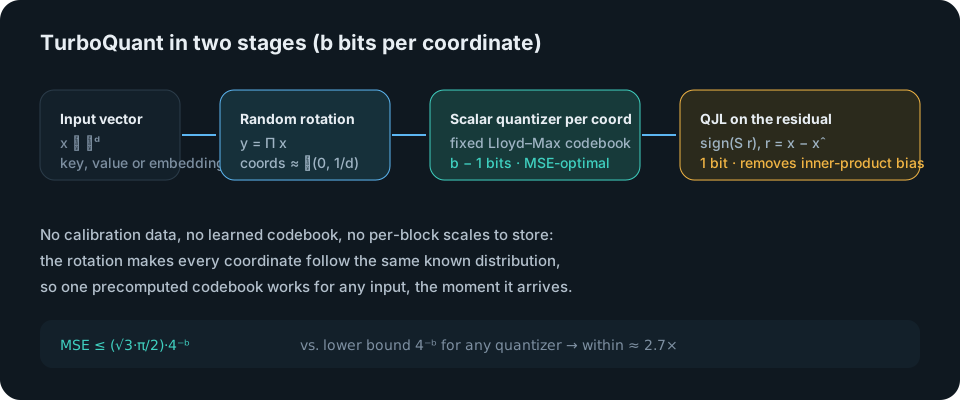 Two stages, no calibration. The rotation does the heavy lifting.
Step 1: rotate
Multiply the input by a random orthogonal matrix . Rotation doesn’t change lengths or inner products, so nothing is lost. But it scrambles where the energy sits. A vector with one huge outlier coordinate becomes a vector whose energy is spread evenly.
The paper makes this precise. For a unit vector rotated uniformly at random, each coordinate follows a known distribution:
This is the key insight. After rotation you don’t need to learn the data distribution, because you already know it. In high dimensions the coordinates are also nearly independent. So a hard vector problem becomes easy scalar problems.
Step 2: one fixed codebook for everyone
Since every coordinate has the same known distribution, you can precompute the best scalar quantizer for it once. This is the classic Lloyd–Max solution, a 1-D k-means over that density. There’s no per-block scale and no learned codebook. Every vector in every layer uses the same tiny table.
How good is this? The paper measures mean-squared error on unit vectors,
and proves that with bits per coordinate
It also proves that no quantizer at all can do better than on hard inputs. The gap between what TurboQuant achieves and what is theoretically possible is a constant, , at every bit-width and dimension. Each extra bit cuts the error by 4×, exactly as the lower bound says it should. At small bit-widths, the actual numbers are about 0.36, 0.117, 0.03 and 0.009 for .
Step 3: fix the bias with one more bit
Here’s a subtle point that I think is the most interesting part of the paper. Attention and vector search don’t care about MSE directly. They care about inner products, . An MSE-optimal quantizer is biased for inner products: it systematically shrinks them. That’s a problem when those scores go through a softmax.
TurboQuant spends bits on the MSE stage, then uses the last bit on the residual with a Quantized Johnson–Lindenstrauss (QJL) sketch:
That’s one sign bit per coordinate, with no stored scale. The combined estimator is unbiased, . Its inner-product error is also bounded within a constant of the matching lower bound:
The practical detail: outlier channels
KV caches have a few channels that are consistently much larger than the rest. The paper’s KV experiments handle this simply. They split channels into outliers and the rest, run two independent TurboQuant instances, and give outliers more bits. Their 2.5-bit setting, for example, uses 3 bits for 32 outlier channels and 2 bits for the other 96:
With this, the paper reports quality neutrality at 3.5 bits per channel and only marginal degradation at 2.5 bits on long-context KV benchmarks. Google’s post adds needle-in-a-haystack results with KV memory reduced “by a factor of at least 6x”. It also reports up to an 8× speed-up for 4-bit attention-logit computation on H100s against an unquantized 32-bit JAX baseline. Those are the authors’ numbers, and that last comparison is against fp32, not the bf16 most of us serve in. I’d still treat them as strong signals rather than guarantees for my own workload.
Why it reached production so quickly
I think there’s a lesson here for anyone doing applied research. TurboQuant spread fast not just because the results were good. It spread because the method has almost no moving parts.
- Data-oblivious. No calibration set, no training step, no codebook to fit. You can drop it into any model, or any embedding pipeline, today.
- Online. Each vector is quantized independently as it’s produced. That’s exactly the access pattern of a KV cache, and of an index that keeps growing.
- Accelerator-friendly. It’s a matrix multiply, a table lookup and a sign. These map neatly to GPU kernels and CPU SIMD.
- Guaranteed. The bound holds for any input, so engineers aren’t betting on the data looking like the paper’s benchmarks.
The timeline shows what that buys you. The paper appeared on arXiv in April 2025. Google’s blog post came out on 24 March 2026. turbovec was created two days later. vLLM merged a TurboQuant attention backend, “2-bit KV cache compression with 4x capacity”, on 15 April 2026. Meanwhile, community ports for llama.cpp and other runtimes appeared under the turboquant topic.
It’s research and engineering looking at the same object from opposite sides of a mirror. The theorist’s question, “what’s the best possible distortion with no knowledge of the data?”, turns out to be exactly the engineer’s constraint: “I can’t calibrate, and I need it to work on whatever shows up.”
The vector-search side: turbovec
turbovec is the clearest example of the idea leaving the paper. According to its README, it:
- normalises each vector and stores the length;
- applies one shared random rotation;
- quantizes each coordinate with a precomputed Lloyd–Max codebook at 2 or 4 bits;
- searches the compressed codes directly with SIMD lookup tables (AVX-512, AVX2, NEON), with a per-vector scalar to correct inner-product bias.
Usage is about as small as it gets:
from turbovec import TurboQuantIndex

index = TurboQuantIndex(dim=1536, bit_width=4)
index.add(vectors)                 # float32, shape (n, 1536)
scores, ids = index.search(query, k=5)
index.sync("index.tv")             # durable, incremental save
The README’s own benchmarks use 100K OpenAI embeddings and compare against FAISS IndexPQFastScan at matched bit rates. They report:
- 4-bit search 3.8–5.1× faster;
- 75 MB instead of 586 MB at ;
- recall@1 within about a point of FAISS.
It’s also honest about the limits: search is a full scan, so latency grows linearly with corpus size, and low-dimensional embeddings lose more recall. For very large corpora you’d still put a graph or IVF index in front.
What I’d check before using it
If I were adding TurboQuant to a production system tomorrow, this is my list:
- Benchmark on your own tasks, not just needle-in-a-haystack. Long reasoning chains and tool-calling tend to show KV-cache damage first, and community reports on aggressive 2–3-bit settings vary.
- Start with keys at higher precision than values, or a mode with 4-bit values. Keys feed the softmax directly, so their errors are amplified.
- Measure latency, not just memory. The rotation and dequantization aren’t free. Gains depend on whether your kernels fuse them into attention.
- Check the exact flags for your version. In vLLM the KV-cache dtype names have changed between releases. Run
vllm serve --helprather than copying a blog post, including this one. - For retrieval, measure recall at your dimension. Expect to rerank the top candidates with full-precision vectors if recall matters more than RAM.
The bigger takeaway
I like this paper because it makes a case for theory that’s easy to forget. The most deployable algorithm is often the one with the cleanest guarantee and the fewest assumptions, not the one with the most tuning knobs. “Within 2.7× of optimal, for any input, with no calibration” is a sentence an engineer can build on.
References
- Zandieh, Daliri, Hadian, Mirrokni. TurboQuant: Online Vector Quantization with Near-optimal Distortion Rate. arXiv 2504.19874, ICLR 2026.
- Google Research. TurboQuant: Redefining AI efficiency with extreme compression. 24 March 2026.
- vLLM. TurboQuant attention backend, PR #38479. Merged 15 April 2026.
- turbovec: a vector index built on TurboQuant (Rust + Python, MIT). Benchmark figures quoted here are from its README; star count checked via the GitHub API on 13 October 2026.
- GitHub topic: turboquant: community ports (llama.cpp, vLLM plugins, WASM).
- Zandieh, Daliri, Han. QJL: 1-Bit Quantized JL Transform for KV Cache Quantization with Zero Overhead. arXiv 2406.03482 (AAAI) — the residual stage TurboQuant builds on.