
Why emotion models fall apart outside the lab (and what actually helps)
Speech emotion recognition looks solved on benchmarks and breaks on real calls. A researcher's tour of domain shift, speaker leakage, metric learning and self-supervised features.

Sattaya Singkul · 7 min read
There’s a moment every speech emotion recognition (SER) researcher goes through. Your model hits a number on a benchmark that would have been state of the art a couple of years ago. You feel great. Then someone plays it a real phone call: a tired customer, a cheap headset, a TV in the background. It confidently says happy.
I want to explain why that happens. It isn’t bad luck. There’s a specific set of reasons. I’ll also cover the ideas that, in my experience, move a model from “good on the leaderboard” to “useful on Monday morning”. There’s some maths, but I’ll keep it honest and practical.
The problem hiding in the datasets
Most classic SER corpora are acted. Professional actors read fixed sentences in a quiet studio, asked to sound angry or sad. EMO-DB has ten German actors. RAVDESS has 24 North American actors and two sentences. These datasets are extremely valuable. They’re also nothing like a real conversation.
Real emotion is subtle, mixed and mostly neutral. Acted emotion is clear, balanced across classes and exaggerated. So a model trained on acted speech learns the loud cues: pitch range, energy and speaking rate. The moment the cues get quieter, it’s guessing.
Researchers have shown this clearly with cross-corpus evaluation: train on one dataset, test on another. Performance drops sharply, even when both datasets are “the same task” (Schuller et al., 2010). If you read only one paper before building an SER product, make it a cross-corpus one.
Three kinds of shift, and the one people forget
When an emotion model breaks, it’s usually one of these:
- Channel shift. Different microphones, codecs, sample rates and noise. The classic telephone band (300–3,400 Hz) throws away exactly the high-frequency energy that acted “anger” leans on.
- Language and culture shift. How people sound when they’re annoyed differs across languages. Tonal languages make this harder still, because pitch carries lexical meaning, not just emotion. A rising tone might be a word, not excitement.
- Speaker shift. This is the one people forget, because it can hide inside your own test set.
With a handful of actors, a random train/test split puts the same voices on both sides. The model can then score well partly by recognising who is speaking, and how that person acts each emotion. That’s speaker identification wearing an emotion costume.
The fix is boring and non-negotiable: speaker-independent splits, ideally leave-one-speaker-out cross-validation. Your numbers will go down. They’ll also start telling the truth.
Measure what matters: unweighted accuracy
Real traffic is heavily imbalanced. Most speech is neutral. A model that always says “neutral” can post a great plain accuracy and be completely useless.
So SER papers report unweighted accuracy (UA), the mean of per-class recall, used since the INTERSPEECH 2009 Emotion Challenge:
Every emotion counts equally, however rare it is. If a product is going to act on “angry”, I care about that class’s recall far more than the overall number.
Idea 1: stop classifying, start measuring distance
A softmax classifier is lazy in a specific way. It only needs to put the training points on the correct side of a boundary. Nothing asks it to make each emotion a tight, well-separated region. Shift the input a little and test points slide across the line.
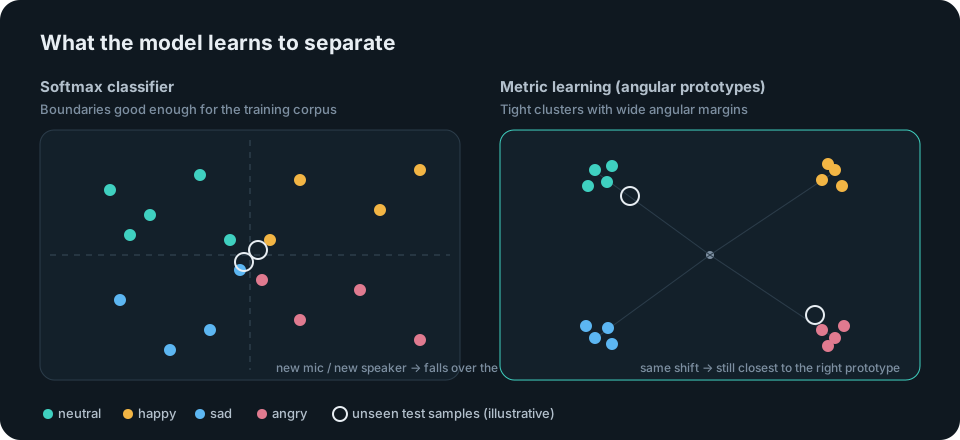 Metric learning gives each emotion its own direction in embedding space, with room to spare.
Speaker verification solved a very similar problem years ago. You can’t train a classifier over every person on Earth, so you learn an embedding where the same speaker lands close together and different speakers land far apart. Then you compare by distance.
The same trick works for emotion. One loss I like is the angular prototypical loss from speaker recognition (Chung et al., 2020). Each mini-batch contains classes with utterances each. For class , the prototype is the mean embedding of its support utterances:
Each held-out query is scored against every prototype with a scaled cosine similarity, where and are learned:
The loss is a softmax over those similarities, pulling each query towards its own prototype and away from the rest:
Two things make this nice for emotion. Cosine similarity ignores the vector’s length, which tends to soak up loudness and channel gain, so it focuses on direction. And the model is pushed to make whole clusters compact, not just to get individual points across a line.
A neat side effect: you can borrow verification’s evaluation too. The equal error rate (EER) is the threshold where false accepts equal false rejects:
It’s a clean, threshold-free way to ask “is this embedding space actually separating emotions?” before you train a classifier on top. Once the embedding is good, the classifier can be almost anything. Even a simple linear model or an SVM does well, and that’s a good sign that the hard work lives in the representation.
Idea 2: let self-supervised models do the listening
The second big shift was self-supervised speech models such as wav2vec 2.0 and WavLM. They learn from huge amounts of unlabelled audio by predicting masked parts of the signal. They hear far more voices, microphones and languages than any emotion dataset could ever contain.
Two practical lessons:
- Don’t just take the last layer. These models are trained so that the top layers serve their pre-training objective, which leans towards phonetic content. Paralinguistic information, how something is said, is often stronger in the middle layers. A learned weighted sum over all layers, as in the SUPERB benchmark, is a strong and cheap default:
- Pool over time carefully. Emotion is spread unevenly across an utterance; a sigh at the end can matter more than the words. Attentive statistics pooling, a weighted mean and standard deviation over frames, usually beats a plain average.
Idea 3: two teachers are better than one
Different pre-trained models are good at different things. One might be robust to noise; another might capture prosody better in your language. Rather than picking one, you can distil several into a single, smaller student.
The classic knowledge-distillation objective (Hinton et al., 2015) mixes the normal label loss with a term that matches the teacher’s softened predictions:
The temperature is the interesting part. Soft targets carry “dark knowledge”. A teacher that says 70% frustrated, 25% neutral tells the student far more than a hard label “frustrated”. With two teachers, you can average their soft targets, or weight each teacher per class according to where it’s strongest. Emotion labels are noisy and subjective anyway, so learning from soft, graded opinions suits them well.
What I’d tell a new student
If you’re starting SER research, or trying to ship it, this is the short version:
- Split by speaker. Always. Then add a cross-corpus test.
- Report unweighted accuracy and per-class recall, not just accuracy.
- Learn a good embedding first. Check it with EER, then classify.
- Start from a self-supervised model and use more than its last layer.
- Test on your real channel early. Record ten minutes of real audio before you train for ten days.
- Be humble about labels. Two people often disagree about emotion. A model that says “I’m not sure” is more useful than one that is confidently wrong.
The gap between the lab and the real world isn’t a final polish step. It is the research problem. Treat it that way from day one, and the benchmark numbers start meaning something.
References
- Burkhardt, F. et al. (2005). A database of German emotional speech. Interspeech 2005 — EMO-DB.
- Livingstone, S. R. & Russo, F. A. (2018). The Ryerson Audio-Visual Database of Emotional Speech and Song (RAVDESS). PLOS ONE.
- Schuller, B. et al. (2010). Cross-Corpus Acoustic Emotion Recognition: Variances and Strategies. IEEE Transactions on Affective Computing, 1(2).
- Schuller, B., Steidl, S. & Batliner, A. (2009). The INTERSPEECH 2009 Emotion Challenge — unweighted accuracy as the headline metric.
- ITU-T. Recommendation P.310 — telephone band (300–3,400 Hz) digital telephones.
- Chung, J. S. et al. (2020). In defence of metric learning for speaker recognition. Interspeech 2020 — angular prototypical loss.
- Baevski, A. et al. (2020). wav2vec 2.0: A Framework for Self-Supervised Learning of Speech Representations. NeurIPS 2020.
- Chen, S. et al. (2022). WavLM: Large-Scale Self-Supervised Pre-Training for Full Stack Speech Processing. IEEE JSTSP.
- Yang, S. et al. (2021). SUPERB: Speech processing Universal PERformance Benchmark. Interspeech 2021 — weighted sum of layers.
- Okabe, K., Koshinaka, T. & Shinoda, K. (2018). Attentive Statistics Pooling for Deep Speaker Embedding. Interspeech 2018.
- Hinton, G., Vinyals, O. & Dean, J. (2015). Distilling the Knowledge in a Neural Network. arXiv:1503.02531.
The diagram is illustrative, not a plot of real embeddings.